Visible-Light Self-Healing Bio-Based Polymer Developed
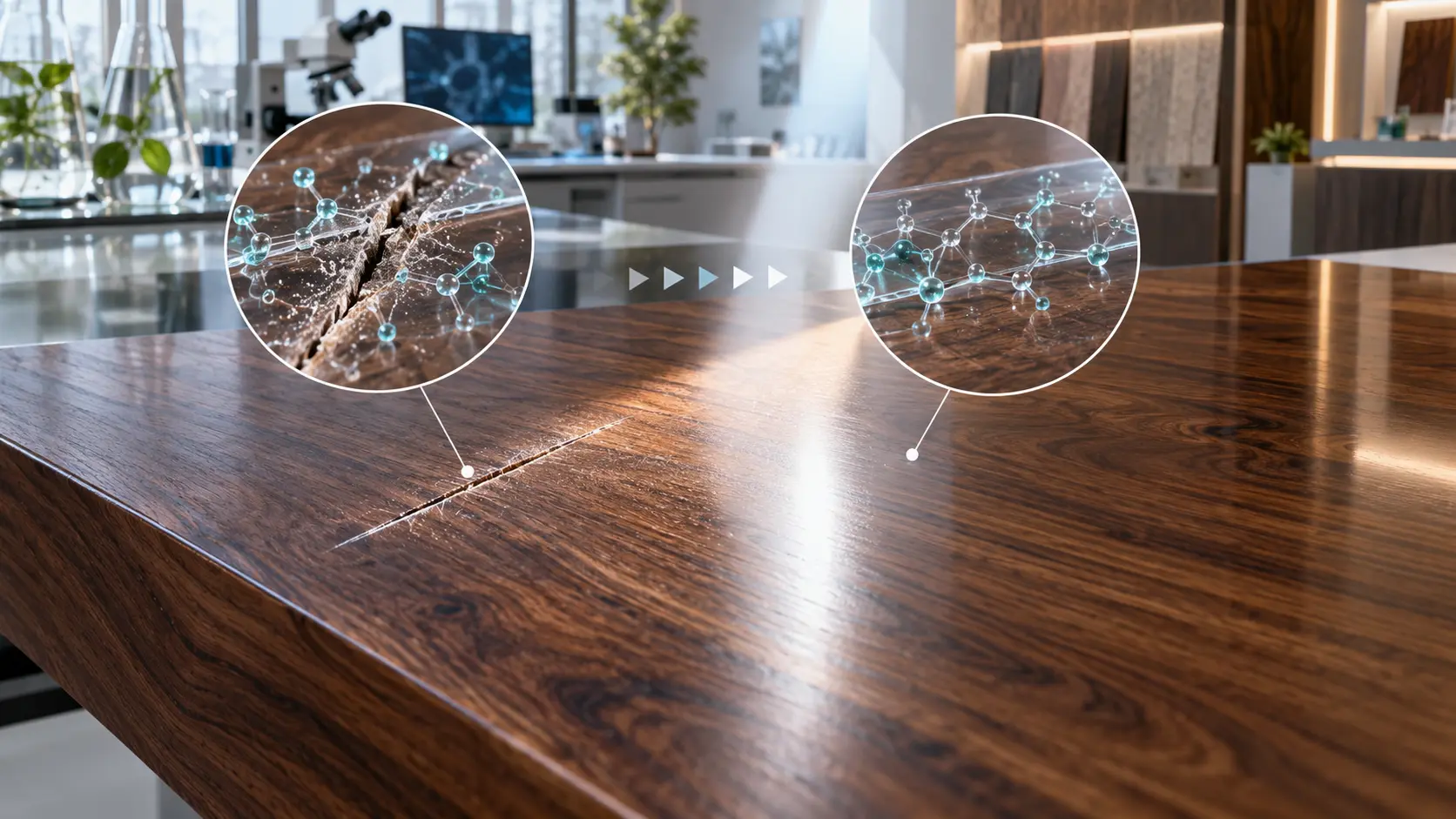
Visible-Light Self-Healing Bio-Based Polymer Developed
A new vitrimer made from vanillin-derived building blocks can self-heal under visible light and undergo closed-loop chemical recycling. The laboratory-stage study offers a notable materials strategy for future scratch-resistant furniture and architectural surface coatings.
A peer-reviewed study published by the Royal Society of Chemistry describes a bio-based vitrimer combining mechanical strength, visible-light-triggered healing and chemical recyclability. The polymer network uses two dynamic mechanisms: imine exchange and visible-light-responsive diselenide bonds.
According to the 25 August 2026 summary by European Coatings, the material can heal under visible-light irradiation at a mild temperature of approximately 45°C. The reported tensile strength reached up to 21.6 MPa, depending on formulation. These values relate to the experimental vitrimer specimens and must not be interpreted as performance data for a commercial furniture film, TPU protection film or architectural finish.
Closed-loop recycling
Under mild acidic conditions, the researchers completely depolymerised the vitrimer and recovered high-purity monomers. These were reused to make new vitrimer material with mechanical properties close to those of the original samples.
This is significant because conventional thermosets are difficult to melt and reshape after curing. Dynamic covalent bonds can remain stable during service while rearranging under controlled heat, light or chemical conditions.
Relevance to furniture and architectural surfaces
The study does not introduce a market-ready coating or protective film. Industrial scale-up, transparency, yellowing, adhesion, chemical resistance, outdoor stability, cost and real-world durability still require validation.
Nevertheless, the underlying design could inform future resins for clear furniture coatings, adhesives and architectural surface films. Repairing micro-scratches without replacing the whole surface could support longer product life and lower material consumption.
MKK® Sector Assessment
Self-healing technology treats protection as a responsive material system rather than only a passive barrier. If commercialised, visible-light-assisted repair could become relevant to frequently used tables, worktops, cabinet fronts and wall panels.
Closed-loop recycling must also be assessed at the complete system level. A recyclable top layer does not automatically make a multilayer film, adhesive and substrate assembly recyclable.
For MKK®, the central lesson is that every self-healing claim should define the required temperature, light, duration and damage conditions. Laboratory healing must not be presented as proven performance on a real furniture surface. Compatibility, optical quality, edge behaviour, cleaning resistance and removal performance would all need separate testing.