Does Transparent SPF Film Change Furniture Appearance?
Does Transparent SPF Film Change Furniture Appearance?
Gloss, colour, surface texture and edge details can affect the appearance of transparent film. Learn how visual change is measured and minimized.
Technical overview
Furniture protection must be treated as a system involving the substrate, finish, adhesive, protective film and use environment. A product description alone cannot establish compatibility. Marble, lacquer, wood, glass and composite surfaces can respond differently to cleaning, adhesive contact, moisture and removal.
Practical evaluation
Before full installation, the surface should be identified, cleaned with a compatible method and tested in a hidden area. The sample should be checked for initial contact, haze, colour or gloss change, edge behaviour and controlled removal. Film should not be installed when the finish is unstable, contaminated, moisture-sensitive or otherwise unsuitable.
Key considerations
- Transparency Alone Is Not Enough: A film being colourless does not mean it will be completely invisible after application. The top coat texture, the adhesive's optical behaviour, film thickness and the surface's existing gloss can change the reflection.
- Glossy and Matt Surfaces: On a glossy surface, low haze and an even reflection are important. On a matt surface, if the film's gloss level does not match the furniture, a local tone difference can occur.
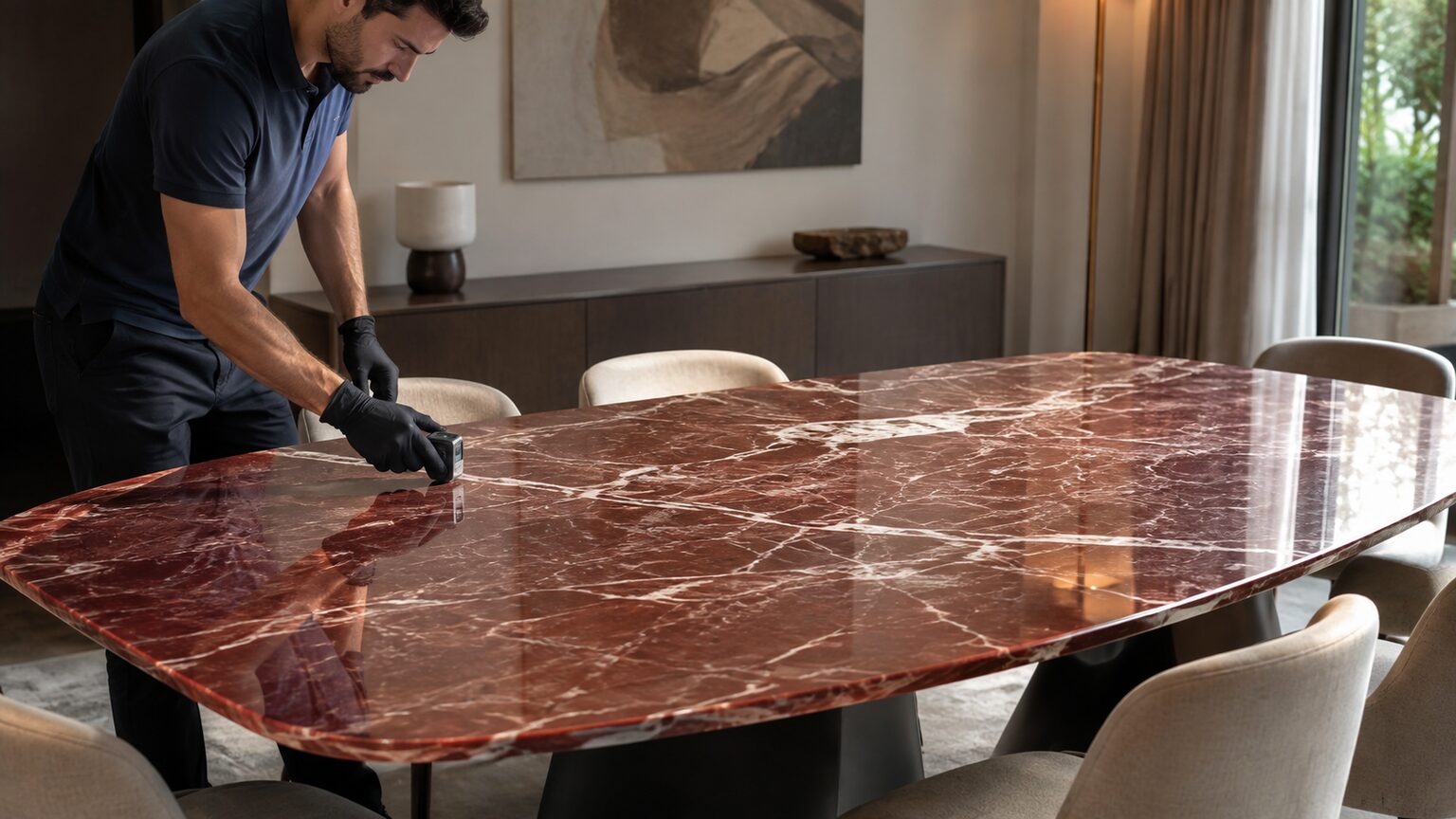
- Measurement and Control: ISO 2813 defines gloss measurement at 20°, 60° and 85° geometries on suitable flat, non-textured coatings. Measurement before and after application supports an assessment that is not made by eye alone.
- Application Quality: A clean surface, dust-free work, correct tension, good edge finishing and suitable product selection preserve visual integrity. A sample application is the safest way to confirm an acceptable appearance.
Installation checklist
- Identify the surface and existing finish.
- Follow the film manufacturer's instructions.
- Test a hidden area before full installation.
- Avoid absolute claims without relevant laboratory evidence.
- Record the product, surface, test result and care instructions.
Conclusion
Transparent surface-protection film can help reduce risks from ordinary use when the complete system is compatible. It does not make furniture impossible to scratch, stain or damage. Reliable results depend on assessment, suitable materials, professional installation and correct maintenance.
Sources and Technical References
About ISO source links: ISO standards are referenced by their standard number and publication year. Links lead directly to the official ISO website; no ISO standards text, images or logos are reproduced here. These references do not imply ISO certification, endorsement, approval or affiliation with MKK. Check the linked official ISO record for the current status of each standard.