Foreign Demand for Furniture Machinery Orders Rises 12.3%
Foreign Demand for Furniture Machinery Orders Rises 12.3%
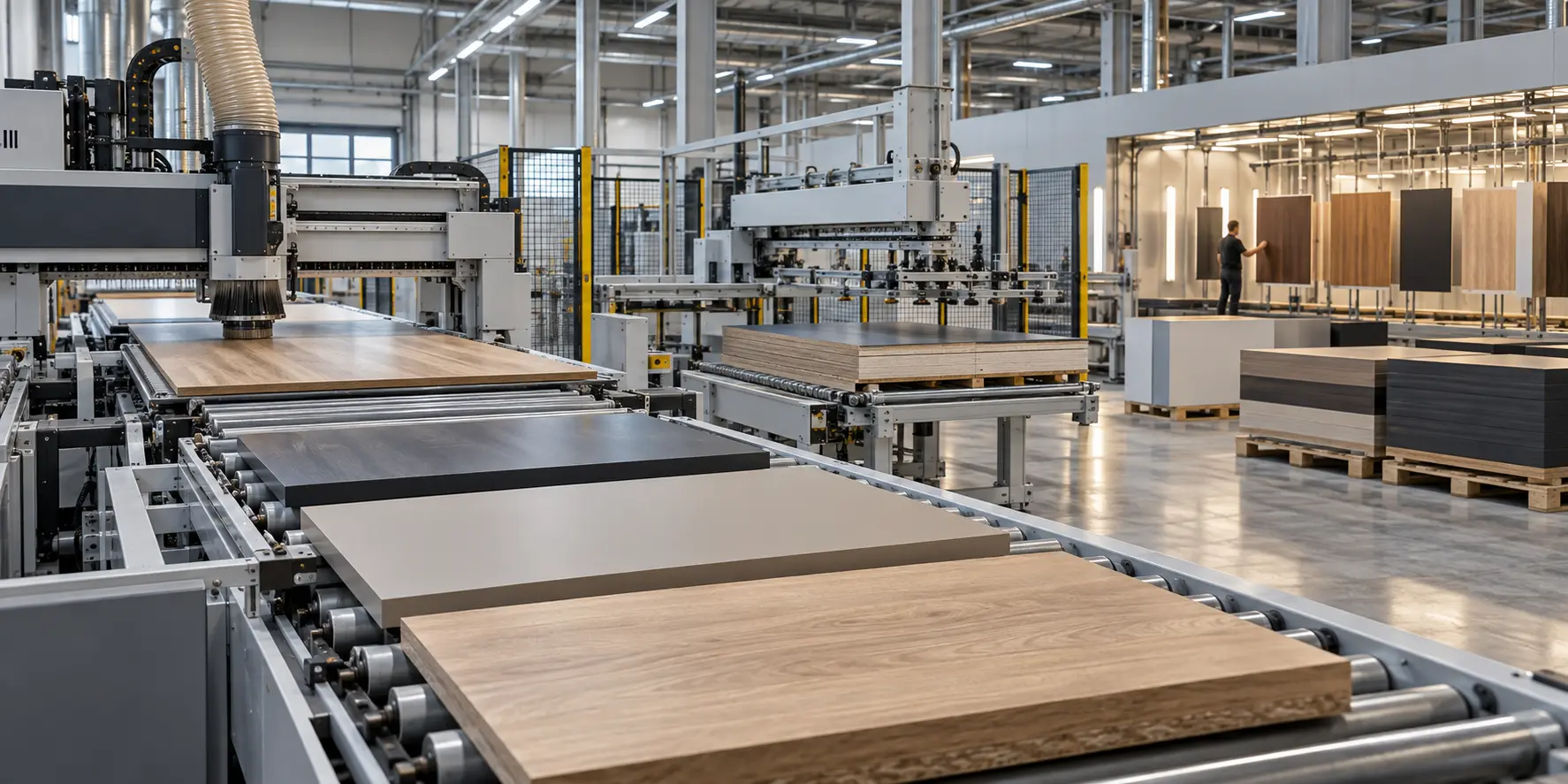
ACIMALL's survey published on 18 September 2026 shows that total orders received by Italian woodworking and furniture machinery manufacturers increased 5.3% year on year in the second quarter. Foreign-market orders rose 12.3%, signalling continued international investment demand for furniture production technology.
The Italian Woodworking Machinery and Tools Manufacturers' Association, ACIMALL, has released the results of its quarterly industry survey for April-June 2026. Conducted every three months among a representative sample of manufacturers, the survey found stronger overseas demand despite continuing geopolitical uncertainty.
Total orders increased 5.3% compared with the same quarter of 2025. Foreign orders rose 12.3%, while domestic Italian orders declined 12.5%. Woodworking Network noted that the result is particularly significant for an industry that exports more than 70% of its output.
Stable production, cautious outlook
Fifty-nine percent of respondents reported broadly stable production, while 18% saw an increase and 23% a decrease. Employment was stable at 82% of surveyed companies; 12% reported growth and 6% a decline.
Average order backlogs stood at 3.5 months. Machinery prices had increased 3.5% since the start of 2026. Inventory was rising at 53% of companies and stable at the remaining 47%; none reported falling inventory.
Expectations for the third quarter were more cautious. For Italy's domestic market, 24% expected higher orders, 41% stability and 35% a decline. For foreign demand, 59% expected orders to remain unchanged, 35% anticipated a decrease and only 6% expected growth.
The figures point to international demand that remains active but uneven. Rising foreign orders show that investment has not stopped, while weaker domestic demand and a cautious outlook suggest manufacturers are becoming more selective about capacity and technology decisions.
Meaning for furniture and architectural surfaces
Investment in woodworking and furniture machinery can support more controlled cutting, CNC machining, sanding, edge processing, handling and finishing. However, ACIMALL's survey does not break the increase down by machinery category. It should therefore not be presented as growth specifically in coating or surface-finishing equipment.
The wider trend nevertheless indicates continued demand for productivity, repeatable quality and lower defect rates. For lacquer, laminate, decorative panels, veneers and high-gloss finishes, protecting completed parts during packaging, transport and installation becomes part of quality management.
Possible implications for Türkiye
Türkiye has substantial furniture, panel, woodworking and interior manufacturing capacity, while Italy is a leading supplier of machinery and production technology to these industries. The 12.3% increase in foreign orders suggests international interest in new equipment remains active and may intensify competition around technology, efficiency and delivery quality.
The survey does not provide country-specific order or investment data for Türkiye. It cannot be used to claim that the Turkish market grew at the same rate. A firm assessment would require separate analysis of Turkish trade, industrial production and sector investment data.
MKK® Sector Assessment
As furniture production becomes faster and more automated, small surface defects carry greater commercial consequences. Scratches, abrasion marks, edge damage and transport-related defects can lead to rework, delayed delivery and customer dissatisfaction. Surface protection should therefore be considered across the chain from production to installation.
Temporary transit films and permanent transparent surface-protection systems serve different purposes. Temporary films must be selected according to substrate, adhesive, dwell time and removal conditions. Permanent systems require evaluation of appearance, edges, cleaning, traffic and eventual removal behaviour.
Lacquered, varnished, laminated and decorative-panel surfaces should not be assumed to be compatible with the same film. Technical data, manufacturer approval and a discreet compatibility test remain essential for preserving the finish achieved through advanced machinery.