Coffee Waste Becomes a Furniture Surface: KAVA in London
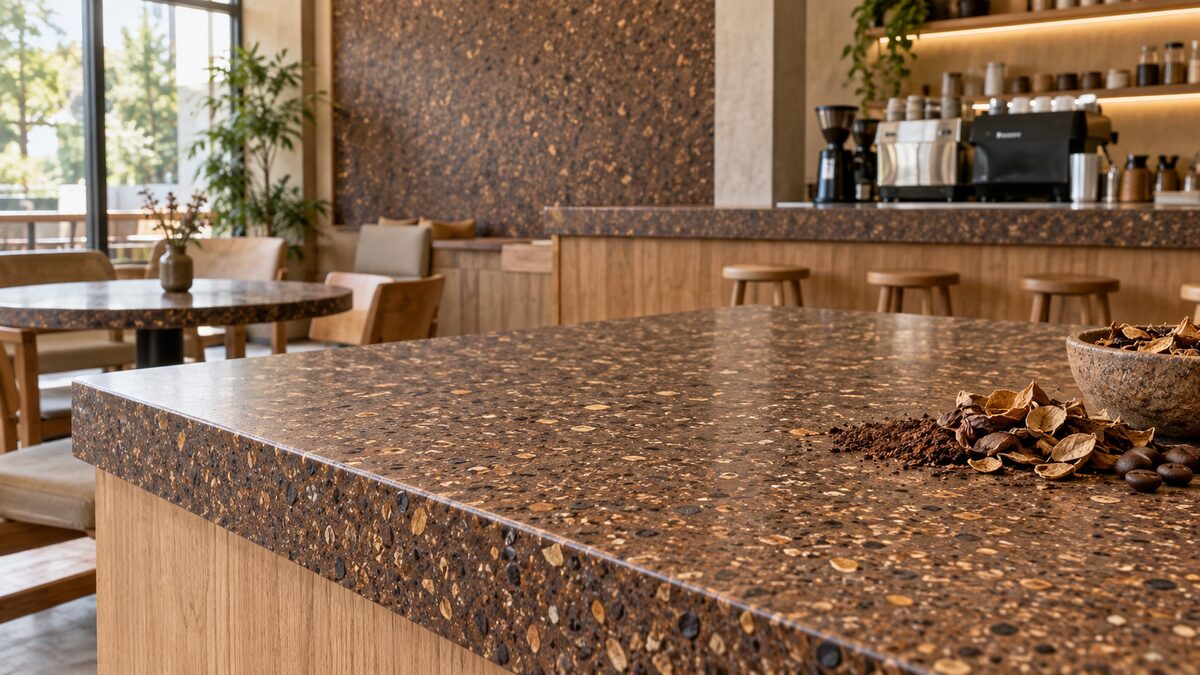
Standfirst: KAVA Surfaces has been named an official material partner of Shoreditch Design Week 2026 with decorative surfaces made from recycled by-products including coffee husks, grounds and fruit stones. Designed for tabletops, counters, cabinetry and wall panels, the system connects furniture production with architectural interiors.
UK materials company KAVA Surfaces was announced as an official material partner by Shoreditch Design Week on 7 September 2026. The development is directly relevant to furniture and architectural finishes because the material is presented not only as a sheet, but as a 1–2 mm decorative top layer applied to FSC-certified wood substrates.
According to the event announcement, the finishes use recycled by-products including coffee husks and grounds, organic fibres such as fruit stones, and mineral matter. KAVA supplies sheets as well as made-to-order fixtures and fittings.
The listed applications span furniture and interior architecture: worktops, tabletops, wall panels, headboards, counters and desks, furniture and cabinetry. This allows a common material language to continue from movable furniture to fitted interior elements.
Three finishing categories
The announcement describes finishes ranging from matte and chalky to glossy. KAVA Eco is positioned for wall panels, decorative surfaces and artwork. KAVA Home uses a water-based sealant and is intended for furniture, tabletops, worktops, cabinetry and domestic kitchens. KAVA Trade is described as the most durable option for high-traffic commercial settings and as fire-rated.
These claims come from the producer and event organiser. For any specification, abrasion, stain, chemical or fire performance should be checked against the relevant technical sheet, test standard, specimen build-up and substrate.
The announcement also says the panels use low-VOC, formaldehyde-free binders. Environmental and indoor-air claims should nevertheless be verified through current certificates and independent test documentation before being written into a project specification.
A materials-led agenda in London
The announcement arrived ahead of Shoreditch Design Week, taking place from 15–20 September as part of London Design Festival. Its trade exhibitions run from 15–17 September and include Material Matters, with categories spanning surfaces, wallcoverings, residential and workplace furniture, and technology.
Material Matters defines its work around material intelligence, circular design, craft and innovation in architecture and design. A 10 September report in The Times also identified unusual inputs such as coffee grounds, oyster shells, river sludge, seaweed and bacteria as a shared theme among materials shown at the event.
KAVA is a practical furniture-surface example of that broader direction. The significance is not simply the reuse of a waste stream; the recycled content remains visually legible and becomes part of the interior design language.
What it may mean for Türkiye
For Türkiye’s furniture, interior design and surface-material industries, the development suggests two opportunities. The first is to assess consistent by-product streams from food and agricultural processing as potential inputs for decorative materials. The second is to design furniture, wall panels, counters and fitted cabinetry through a shared surface system.
Not every organic waste stream can become a reliable finish. Moisture, particle size, colour stability, odour, biological durability, binder compatibility and manufacturing repeatability must all be solved. Comparable developments in Türkiye would need mechanical, emissions, fire and maintenance evidence alongside visual design.
MKK® Sector Assessment
The KAVA example shows how the boundary between furniture and architectural finishes is increasingly defined by surface design. Reconsidering the top layer without automatically discarding the structural body may support visual continuity across tables, counters, cabinetry and walls while retaining the value of a sound substrate.
The product categories should not be confused. KAVA’s system is a composite decorative layer applied to a wood substrate in production or workshop conditions; it is not a self-adhesive architectural film or a transparent surface-protection film. The approaches nevertheless meet around a common lifecycle objective: keep a technically sound substrate, renew its surface and extend the usable life of the element.
Organic-textured finishes also create a separate compatibility question for protective films. Porosity, surface energy, finish hardness and water-based sealers can affect adhesion and removal. Manufacturer approval, current technical data and a discreet sample test are therefore necessary before applying a decorative or protective film to such a surface.
The wider lesson is that refurbishment and protection cannot be reduced to one material. Bio-composite top layers, architectural films and transparent protective films may be alternatives or complements depending on substrate condition, traffic, care requirements and verified performance.
Sources
- Shoreditch Design Week – “Announcing Kava Surfaces as an official Material Partner” – 7 September 2026
- Shoreditch Design Week – “Material Matters” event and exhibitor page – Accessed 14 September 2026
- Material Matters – “Material Intelligence for Architecture and Design” – Accessed 14 September 2026
- The Times – “River sludge, seaweed and bacteria — the materials of the future” – 10 September 2026