Selecting TPU and TPH Protection Films for Furniture
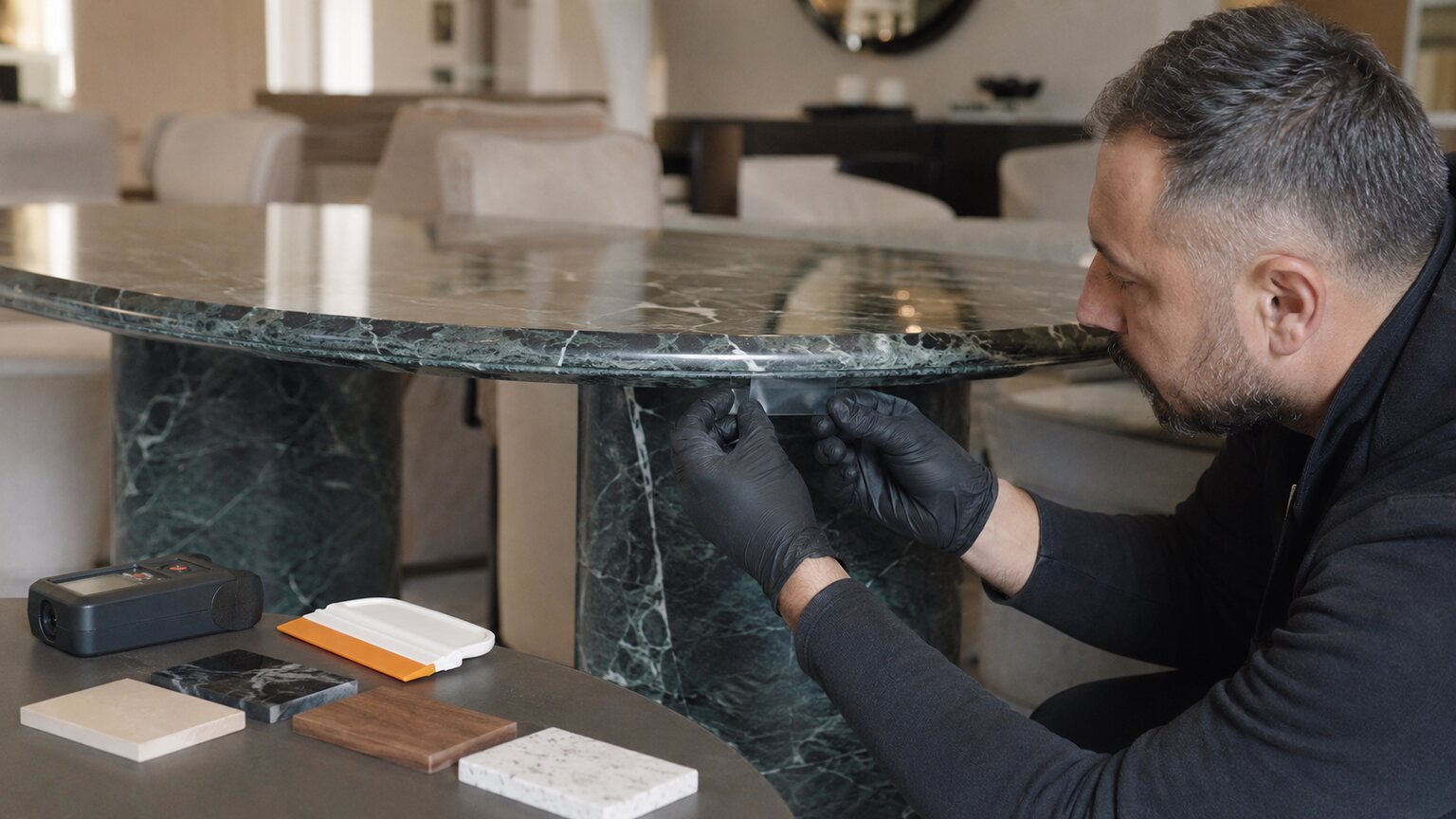
How Should a Protection Film Be Selected for Furniture and Architectural Surfaces?
The correct protection film cannot be selected by material name or thickness alone. A safe application requires the film, adhesive, surface finish and expected use conditions to be evaluated as one system.
Marble tables, lacquered consoles, natural wood, quartz countertops and glass may appear similar, but their chemical and physical properties differ. A transparent film that performs well on one surface can produce edge lifting, gloss variation or finish damage during removal on another.
The first step in a professional installation is therefore not full application, but a surface compatibility test.
The Basic Difference Between TPU and TPH
TPU, or thermoplastic polyurethane, is a defined polymer family. Its flexibility, mechanical strength and abrasion resistance can make it suitable for protective-film construction. Covestro describes TPU films as materials offering flexibility across a wide temperature range, mechanical strength and abrasion resistance. These general properties do not mean that every TPU film performs identically. Formulation, topcoat, adhesive and manufacturing process all affect the final result.
TPH, by contrast, is commonly used in the market as a commercial description for different film constructions. The term alone does not verify polymer composition or performance. A useful comparison should examine:
- Chemical structure of the base film
- Total construction thickness
- Topcoat technology
- Adhesive type and adhesion level
- Heat, UV, stain and abrasion test data
- Behaviour during removal
- Supported surface list
Thickness Is Not a Complete Performance Indicator
A thicker film is not automatically a better protective film. Thickness must be considered together with flexibility, edge conformity, optical appearance and impact-damping behaviour.
A relatively rigid film may perform adequately on flat glass but retain stress around an oval table edge and lift over time. A very flexible film may install easily, yet show wear sooner if its topcoat is not designed for repeated contact. Technical evaluation should never stop at the question “How many microns?”
Pre-Installation Compatibility Check
A field check should be carried out on a small, hidden part of the furniture:
- Clean the area and identify the existing lacquer, paint or factory finish.
- Apply a small film sample.
- Observe initial adhesive contact.
- Check for haze, colour shift or surface reaction.
- Remove the sample in a controlled manner after the defined waiting period.
- Inspect for finish lifting, adhesive residue or gloss difference.
Film should not be installed where compatibility cannot be established.
What Do Laboratory Standards Actually Measure?
Laboratories may use methods such as ISO 2409:2020 or ASTM D3359-23 to assess coating separation or rate whether adhesion is adequate for an application. ISO 2409 specifically notes that its cross-cut classification is not a direct quantitative adhesion measurement.
Appearance also matters. ISO 2813:2014 defines gloss measurement at 20°, 60° and 85° for suitable flat, non-textured coatings. Measurements taken before and after installation can help identify a meaningful change in appearance.
For wear testing, ASTM D4060 covers abrasion testing of organic coatings on plane, rigid surfaces using a Taber Abraser. ISO 4892-3:2024 describes controlled exposure of plastic specimens to fluorescent UV radiation, heat and water for laboratory weathering evaluation.
Mentioning a standard does not prove that a product complies with it. A compliance claim requires the relevant specimen, defined test conditions and a traceable laboratory report.
Conclusion
A dependable surface-protection system is determined by the interaction between the film, adhesive, furniture finish and use environment. Absolute claims such as “works on every surface,” “cannot be scratched” or “lifetime protection” are not technically reliable.
The correct process is to inspect the surface, test a hidden area and proceed with professional application only when compatibility has been established.