Protective Film Sample Approval: Assessing Appearance
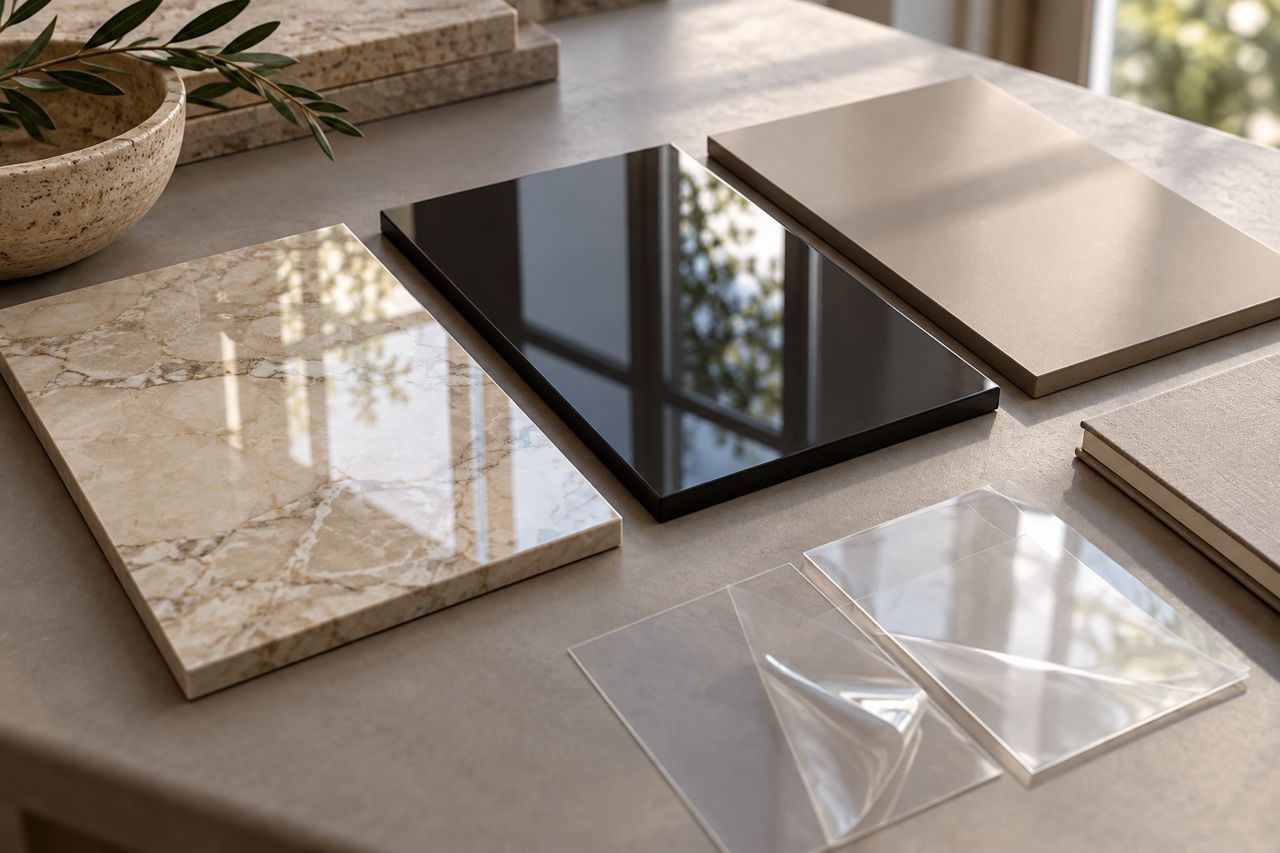
A protective-film sample helps align a customer's appearance expectations with the result an applicator observes. This lesson offers a practical recording workflow. It does not replace the product instructions or a surface-suitability assessment.
Separate appearance from suitability
Visual approval concerns the chosen finish. Technical assessment concerns the product and the actual substrate. An attractive sample alone does not approve an entire application.
MKK® excludes edge-banded products because of swelling risk. Visual approval cannot override that scope.
Record the starting condition
Photograph the surface and note existing scratches, dull areas and reflections. Ask which feature the customer wants to retain: colour appearance, gloss, matte finish or tactile character.
Replace vague expectations with a specific statement. For example: “The table veining should remain visible; any gloss change will be assessed using the sample.”
Identify the sample
Record the product code, finish, substrate and date. A sample on another material does not automatically represent the customer's surface.
For an applied sample, follow product instructions for preparation, location and review timing. Do not assume one waiting period works for every film and surface.
Review in the intended space
Where possible, view the sample under the furniture’s daylight and interior lighting. Assess the normal viewing angles. Photographs help with documentation, while customer and applicator should discuss the physical sample.
Record the decision
Include the surface, intended appearance, sample identity, viewing conditions, observed differences and the decision to accept, review another sample or stop. Record who reviewed it.
“Sample seen” is less useful than a description of what was accepted. Appearance approval is not an unlimited performance promise.
Reassess changed selections
If the product, finish or substrate changes, update the sample review. Discuss edge and joint detailing separately from the flat upper surface.
Practice
For an example project, write the appearance to retain, the sample to review and the acceptance criterion. Complete the record and identify missing information before making the application decision.