Protecting Marble Surfaces: The Materials Science Behind Film Application
Why Marble Is Chemically Fragile
Marble is a metamorphic rock formed when limestone recrystallizes under heat and pressure. Its primary chemical constituent is calcium carbonate (CaCO₃) — the very mineral responsible for its prized crystalline sheen. Unfortunately, that same chemistry makes marble surprisingly vulnerable to some of the most common liquids found in any kitchen or living space. This article looks at marble's two core weaknesses — acid reactivity and porosity — and how a film barrier addresses both at the material level.
Acid Etching: A Genuine Chemical Reaction
Calcium carbonate reacts readily even with weak acids. Everyday kitchen liquids — lemon juice (citric acid), vinegar, tomato sauce, coffee, cola — typically sit in the pH 3-5 range, and on contact with marble the reaction proceeds roughly as follows:
CaCO₃ + 2H⁺ → Ca²⁺ + H₂O + CO₂
This reaction physically dissolves the top layer of crystalline structure. The result isn't a stain — it's permanent textural damage: a dull, matte ring (an "etch mark") appears on the polished surface because the crystal structure no longer reflects light uniformly. Wiping or cleaning cannot undo this, because there's no contaminant sitting on top to remove — the stone itself has been chemically altered. Reversing it requires professional honing and repolishing.
Porosity: The Second Weak Point
Marble is a semi-permeable material with microscopic voids between its crystal grains. Even on a polished surface, these pores appear sealed at a glance but remain open at the micro scale. Oils, wine, and coffee that seep into them create stains that surface cleaning cannot remove — only a deep-extraction poultice treatment can partially draw them back out.
Thermal Stress: A Third, Less-Discussed Vulnerability
A less-discussed sensitivity of marble is its response to sudden temperature change. Setting a pot fresh from the oven directly on a marble surface causes the different minerals within the crystal structure to expand at different rates; repeated over time, that micro-scale expansion mismatch can produce fine cracks along crystal boundaries (micro-fissures). No single incident causes visible damage, but the effect accumulates, contributing to surface dullness and brittleness over the years. Protection film acts as a thin thermal buffer between a hot object and the marble beneath, softening the intensity of that sudden heat transfer — a third, less obvious benefit the film provides.
Where Traditional Solutions Fall Short
Marble protection has traditionally relied on two approaches:
- Impregnating sealers: these chemically fill the pores to slow liquid absorption, but they do nothing against acid etching — a sealer doesn't stop calcium carbonate from reacting with acid, it only slows how fast the liquid reaches the pore. Sealers also degrade over time (typically within 1-2 years) and require reapplication.
- Epoxy/resin coatings: these form a permanent barrier but are essentially irreversible — near-impossible to remove, and they typically alter the stone's natural look and feel.
The Physical-Barrier Approach of TPU Film
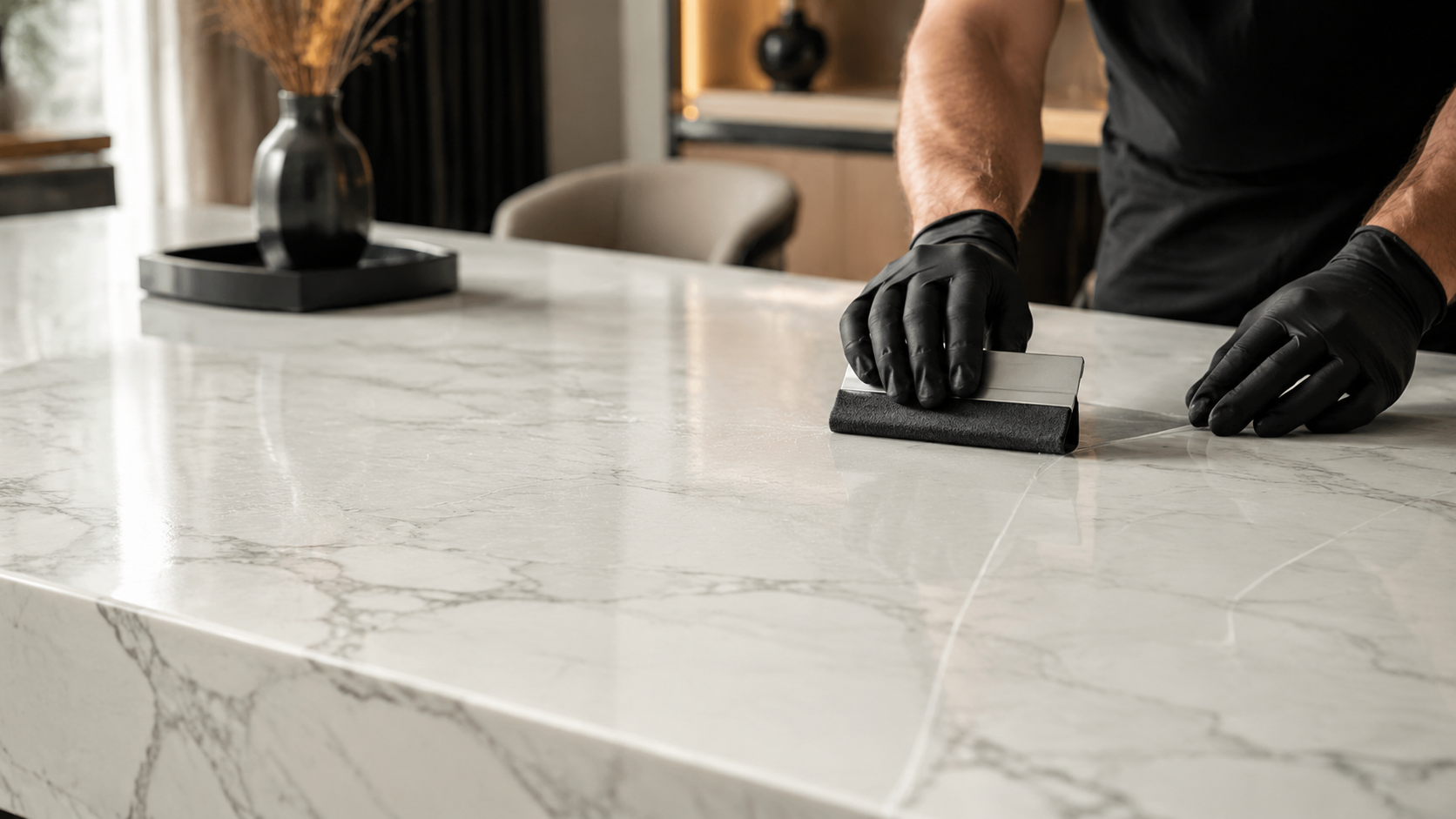
SPF-190 Premium TPU film addresses marble's weaknesses with a physical barrier rather than a chemical one. Applied with continuous, full-contact adhesion, the film completely severs direct contact between acidic liquids or moisture and the calcium carbonate surface below. As a result:
- The acid-base reaction never occurs, because the reactive liquid never reaches the stone.
- Pore infiltration becomes impossible, since the film forms a continuous impermeable layer over the entire porous surface.
- Because the film is transparent with high optical clarity, marble's veining and natural luster remain fully visible and unaltered — unlike sealers, it introduces no visual change.
- Unlike a sealer, it isn't permanent: it can be removed and renewed without damaging the surface, which simplifies long-term maintenance.
The Mechanical Protection Layer
Beyond the chemical barrier, the film also acts as a mechanical buffer against knife scratches, impact from heavy objects, and everyday abrasion. Marble sits around 3-4 on the Mohs hardness scale — softer than many kitchen items, including steel cutlery and ceramic cookware, and easily scratched. The 190-micron TPU layer absorbs the bulk of that impact and friction energy before it ever reaches the marble.
What the Materials Science Tells Us
Protecting marble isn't an aesthetic preference — it's a requirement dictated by the stone's own chemistry. TPU protection film neutralizes marble's core vulnerabilities, acid reactivity and porosity, through a fully reversible physical barrier that leaves the surface's appearance completely unchanged — making it a more effective and more flexible solution than traditional sealers or epoxy coatings.