Inside SPF-190 Premium TPU Film: Layer Structure and Technical Specifications
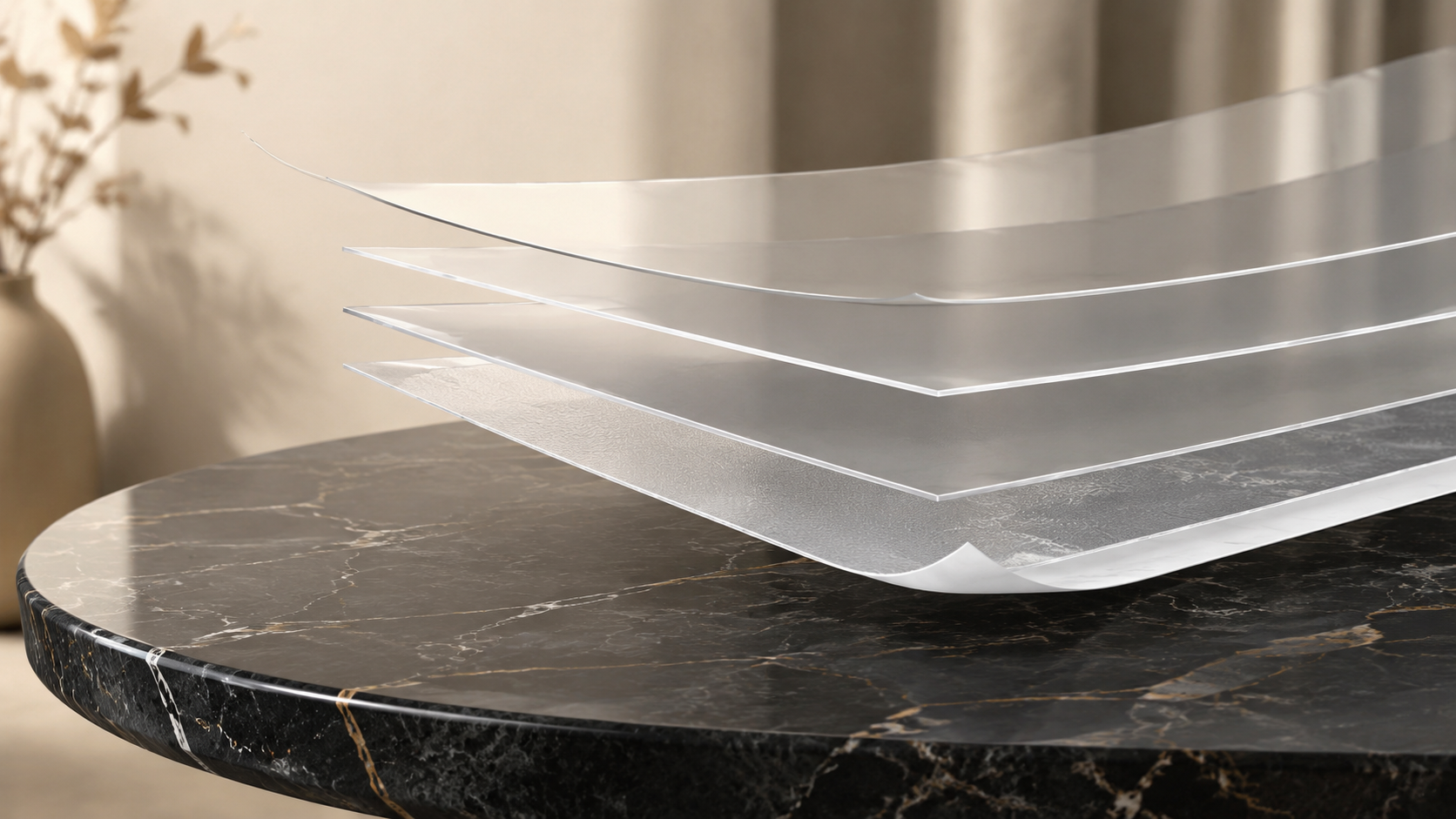
One Film, Three Functional Layers
Although SPF-190 Premium TPU looks like a single sheet of plastic, it is engineered as a three-layer system, with each layer performing a distinct mechanical or optical function. Here we break the film down layer by layer and explain why 190 microns is not an arbitrary thickness choice.
1. The Top Coat
The outermost surface of the film is a thin, hardened layer that takes the brunt of daily abrasion and UV exposure. It has to satisfy two competing requirements at once: be hard enough to resist scratching, yet remain flexible enough to move with the TPU body beneath it without cracking. In the glossy variant, this layer is optically flattened to mirror the surface's natural shine; in the matte variant, a micro-textured finish scatters light at a controlled angle. Either way, the true color and texture of the underlying furniture or stone passes through undistorted — the film behaves as transparent armor, not a filter.
2. The TPU Core — Why 190 Microns
The layer that gives the product its name is the main body: thermoplastic polyurethane roughly 190 microns thick (for comparison, a human hair averages 70-100 microns). This thickness is a deliberate trade-off:
- Thinner films (in the 80-120 micron range) absorb impact poorly, which becomes a real weakness at exposed edges — marble corners, table rims, and similar impact-prone zones.
- Thicker films lose the flexibility needed to conform to curved geometry (console edges, oval coffee table profiles), raising the risk of bubbling and creasing.
190 microns strikes a balance: enough thickness to absorb the everyday impact and abrasion scenarios furniture and architectural surfaces actually encounter, while retaining enough elasticity to wrap complex shapes. TPU's polymer chain structure also has a molecular-level "memory," which is the physical basis of the film's self-healing behavior: light scratches largely disappear when heat (sunlight, warm ambient air, or a light heat-gun pass) prompts the polymer chains to relax back toward their original configuration.
3. The Adhesive Layer
The bottom layer is typically an acrylic-based, low-tack adhesive engineered to satisfy two seemingly contradictory goals: hold firmly enough that the film never shifts under daily use, yet release cleanly — without residue, staining, or lacquer damage — when removal or reapplication is needed. This matters enormously on lacquered furniture and finished wood, where aggressive adhesives can pull the lacquer layer up with them on removal. A minimal-tack formulation removes that risk entirely.
Optical Clarity: The Goal Is to Disappear
The single biggest success metric for a protection film is that nobody notices it's there. SPF-190's optical performance comes from high light-transmission, low-haze TPU resin, so that the veining in marble, the natural grain of wood, or the depth of a lacquered finish reads through the film with no visible clouding.
The Fourth Component During Installation: The Release Liner
During manufacturing and shipping, a thin silicone-coated release liner sits beneath the film to protect the adhesive layer. This liner isn't a permanent part of the finished product — it exists solely to keep the adhesive free of contamination, dust, and premature contact until the moment of installation, when the applicator peels it away. The liner's smoothness and uniform thickness matter more than they might seem: they keep the adhesive layer undisturbed and undeformed right up until application, which indirectly affects the quality of the final bond.
Choosing Between Matte and Glossy
The glossy finish is the natural fit for already high-polish marble, granite, and lacquered surfaces, since it preserves the original aesthetic exactly. The matte finish suits more organic, natural-looking wood and stone surfaces, cutting glare and emphasizing the tactile character of the material. Both variants share the identical 190-micron TPU core and adhesive chemistry — the only difference is how the top layer is optically finished.
The Takeaway
Rather than thinking of SPF-190 Premium TPU as a single sheet of plastic, it's more accurate to treat it as a three-function system where thickness, optical clarity, adhesive chemistry, and surface finish are each solving a specific engineering problem. Combined, they produce a protective layer that is simultaneously invisible and durable.