What Does Film Thickness Mean and How Should Micron Values Be Read?
What Does Film Thickness Mean and How Should Micron Values Be Read?
Micron values describe thickness, not total performance. Base film, topcoat, adhesive, flexibility and surface conformity must be evaluated together.
Technical overview
Furniture protection must be treated as a system involving the substrate, finish, adhesive, protective film and use environment. A product description alone cannot establish compatibility. Marble, lacquer, wood, glass and composite surfaces can respond differently to cleaning, adhesive contact, moisture and removal.
Practical evaluation
Before full installation, the surface should be identified, cleaned with a compatible method and tested in a hidden area. The sample should be checked for initial contact, haze, colour or gloss change, edge behaviour and controlled removal. Film should not be installed when the finish is unstable, contaminated, moisture-sensitive or otherwise unsuitable.
Key considerations
- What Does a Micron Measure?: One micron is one thousandth of a millimetre. The value given in the technical datasheet may refer only to the main film layer or to the total structure including the adhesive and carrier layers.
- Thickness and Behaviour: Thickness can help dissipate impact energy; however, it is not sufficient on its own if the hardness, elasticity and top coat are weak. A thick but rigid product can hold tension on rounded edges.
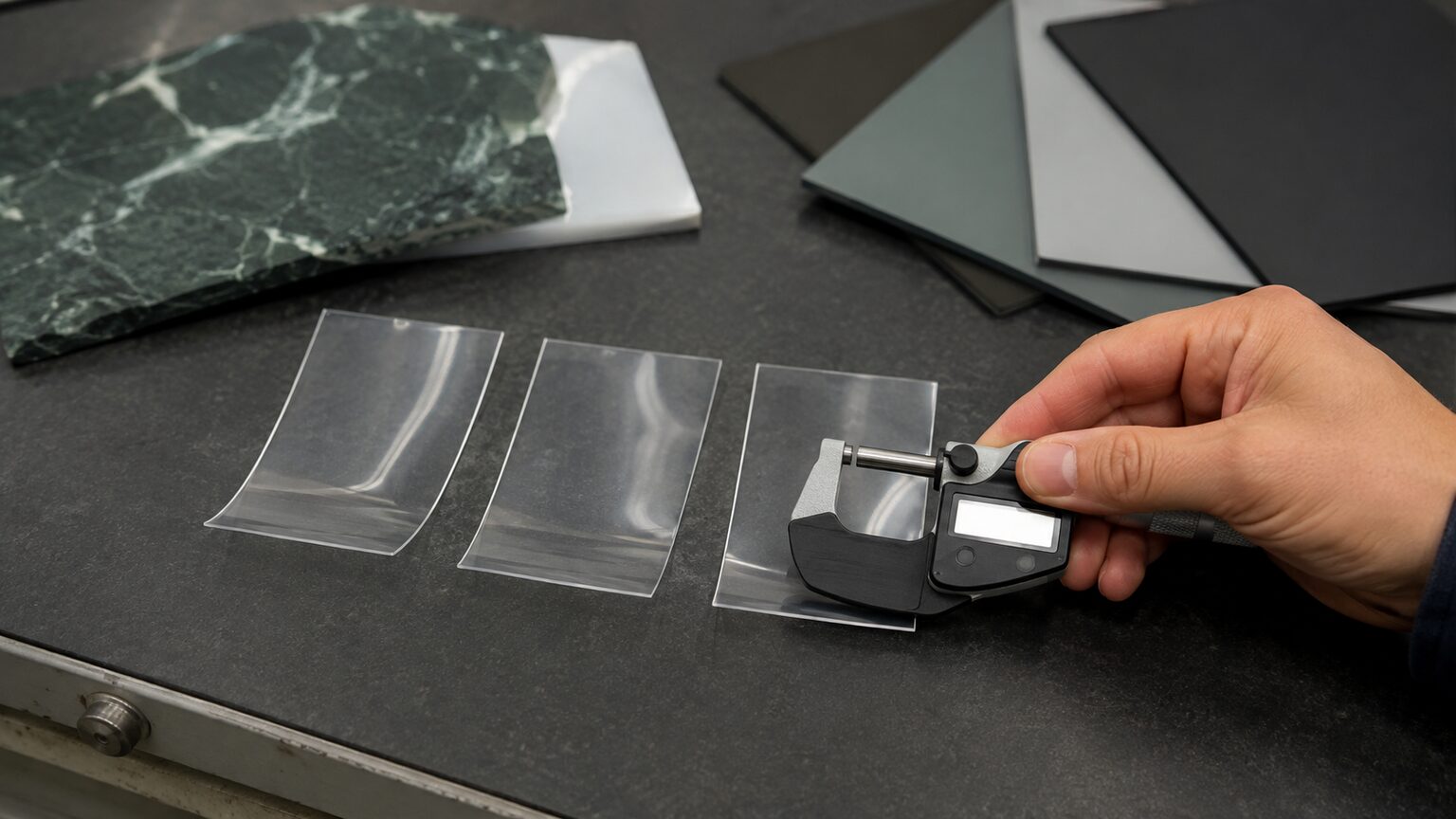
- Measurement Conditions: Thickness should be checked with a calibrated instrument, at multiple points, and with a measuring force that does not compress the product. For adhesive products, the release liner should not be included in the measurement.
- Purchase Check: The technical datasheet should show the main polymer, total thickness, top coat, adhesive type, optical clarity and recommended surfaces together. A 'better protection' claim based only on a high micron value is an incomplete assessment.
Installation checklist
- Identify the surface and existing finish.
- Follow the film manufacturer's instructions.
- Test a hidden area before full installation.
- Avoid absolute claims without relevant laboratory evidence.
- Record the product, surface, test result and care instructions.
Conclusion
Transparent surface-protection film can help reduce risks from ordinary use when the complete system is compatible. It does not make furniture impossible to scratch, stain or damage. Reliable results depend on assessment, suitable materials, professional installation and correct maintenance.